
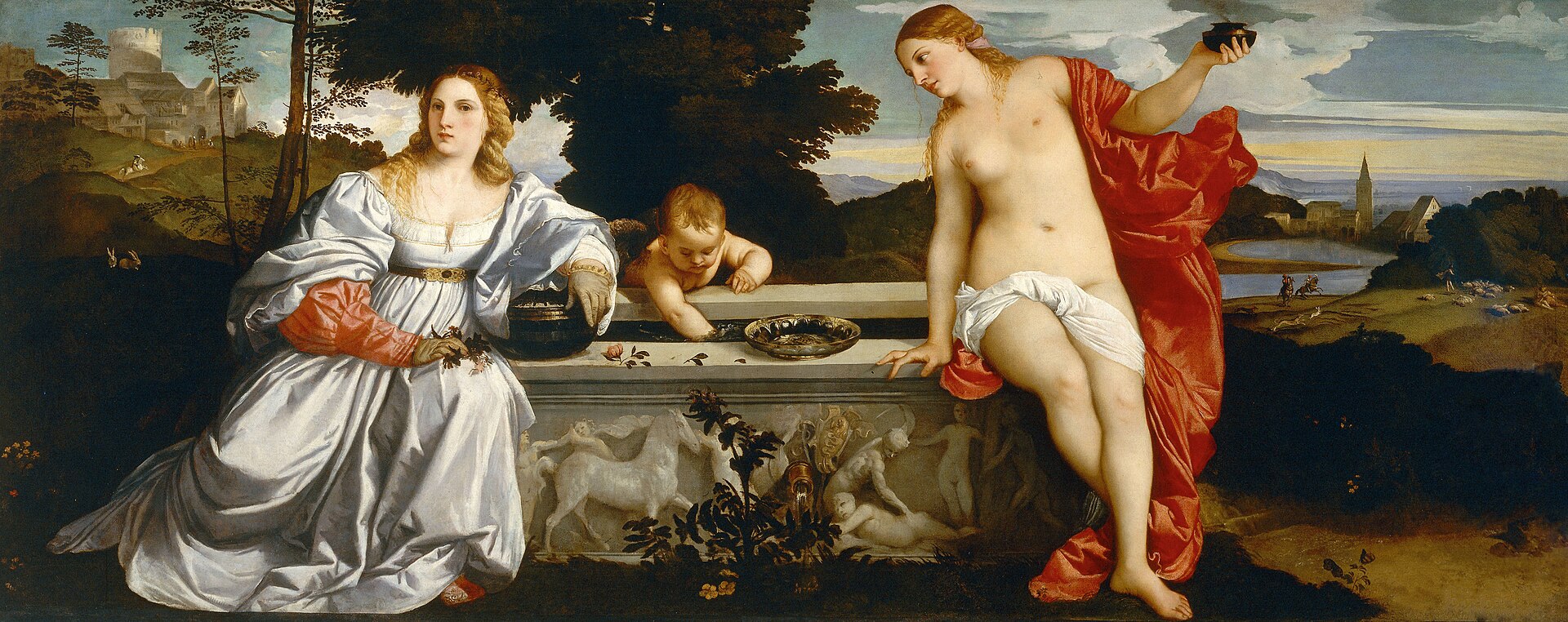
"提香的《神圣与世俗之爱》:这是一幅复杂的寓言画,探讨了二元性和人类情感的主题。
神圣与世俗之爱 is the kind of painting that makes you slow down even in a museum built for fast “highlights.” Inside the 博尔盖塞画廊, Titian’s scene holds you in a quiet tension: two women, a shared presence, and a story that refuses to be reduced to one easy meaning. Tiqets describes it as a centerpiece of the Venetian Renaissance, painted around 1514, and that sense of importance is easy to feel when you stand in front of it. The work is direct and subtle at the same time, offering beauty first and complexity second, as if it’s testing whether you’re willing to look beyond the surface. If you’re visiting 罗马 for art that stays in your head long after the trip, this is one of the paintings that earns its reputation.
See Titian’s masterpiece inside the Borghese Gallery today
The reason this visit feels different starts with the place itself. The 博尔盖塞别墅 rooms are not endless corridors; they’re intimate spaces built to frame masterpieces at close range. Tiqets highlights that the collection is spread across two stories and 22 rooms, and that scale matters because it forces focus. You’re not wandering for hours hoping to “bump into” something great. You are moving from one high-impact room to the next, with the feeling that every wall and every corner is part of a curated argument about taste, power, and beauty. That’s also why Titian’s 神圣与世俗之爱 lands so strongly here: it’s surrounded by works that set your standards high, and it still holds its own without needing a spotlight or a special setup.
The best way to approach the painting is to treat it like a short conversation, not a quick snapshot. Start from a few steps back and let the composition settle. Then move in close and notice how the story is built through contrasts rather than loud symbolism. Tiqets notes that the figures are often interpreted as representing different aspects of love, which gives you a practical lens without locking you into a single reading. Instead of trying to “solve” the painting, let it work on you: what feels serene, what feels charged, what seems deliberately ambiguous. In a gallery where time is limited, this is one of the pieces worth giving five full minutes, because it keeps revealing itself the longer you stay with it.
Of course, a Borghese visit is never only one artwork, and that’s part of the appeal. The gallery is famous for its concentration of giants: 贝尔尼尼 sculptures that feel alive in stone, 卡拉瓦乔 paintings built from drama and shadow, and Renaissance masterpieces that remind you how much skill can fit inside a single frame. Tiqets specifically calls out works like Raphael’s 取证 and positions Titian’s painting within that “High Renaissance” level of quality. This is why planning matters. When you know what you’re coming for—Titian first, then the rooms around it—you leave with a memory that feels intentional, not accidental.
Timed entry rules that shape your two-hour visit
Unlike museums where you can drift in and out, the 博尔盖塞美术馆 is defined by timing. Tiqets is clear that time slots are mandatory and divided into 2-hour slots, and you are required to exit at your designated time. That’s not a drawback; it’s a structure that helps the visit stay more controlled. But it does change how you should plan the day. Build your route around what matters most to you, and arrive early—Tiqets states you must arrive at least 30 minutes before your scheduled entry time, and if you are late your mandatory exit time does not change. In other words, punctuality protects your art time, and that’s exactly what you want if Titian is your priority.
There are also practical rules that can make or break the experience if you ignore them. Tiqets notes a mandatory bag check and that medium and large bags cannot be brought into the museum; only small fanny packs and purses up to 21 x 15 cm are allowed. It also notes that you’ll show your digital or printed ticket at the entrance and exchange it for an official physical ticket. These details matter because they shape your entry rhythm. The smoother your arrival, the more mental space you have to actually look at 神圣与世俗之爱 with attention, instead of feeling rushed by logistics.
If you’re deciding how to visit, Tiqets offers different options depending on how much context you want around the artwork. You can choose a simple reserved entry approach when you’re confident navigating on your own, or pick a guided option when you want an expert to connect Titian’s painting to the wider story of the collection. Either way, the most important thing is to secure a slot in advance, because Tiqets emphasizes that tickets are in high demand and can sell out well ahead. When your time is limited and the collection is this concentrated, booking early is not just convenience—it’s the difference between seeing the painting in person and settling for a photo later.
When you’re ready to secure your preferred timeslot through the supplier, book with Tiqets using this official Borghese Gallery ticket page and build your visit around the moment you meet Titian face to face.
Leave the gallery with one simple intention: carry the painting back into the city. After you step out into 博尔盖塞别墅 park, notice how your eye has changed—how you read light, skin tones, and symbolism differently. That’s the quiet payoff of a work like 神圣与世俗之爱. It doesn’t just impress you in the room. It recalibrates your attention, and it makes the rest of 罗马 feel sharper, richer, and more worth looking at closely.
Useful Information
What you’re booking: Your Tiqets link leads to the 博尔盖塞画廊 ticket hub, where you can choose between multiple visit formats depending on how you want to experience the collection and plan around the mandatory timeslots. The gallery operates with compulsory 2-hour visiting slots, and visitors must exit at the designated time, so selecting the right option is mainly about how much guidance and add-ons you want.
Main entry option: Borghese Gallery: Reserved Entry includes entry to the Borghese Gallery. At checkout, Tiqets may offer upgrades such as Reserved Entrance + Digital Audio Guide or a Hosted Entry Ticket designed to help you access the gallery more smoothly.
Guided options: Tiqets also offers Borghese Gallery: Guided Tour (2 hours, max group size 15) with reserved entrance, a guided tour, and a headset to hear the guide. There’s also a Small Group Guided Tour (2 hours, max group size 15) with reserved entrance, live guide, guided tour, and headset. For a tailored visit, Private Guided Tour includes an entry ticket plus a private tour with a live guide (max group size 9), and the guide adapts the visit to your interests.
City combo: If you want to pair art with sightseeing, Tiqets sells a 3-hour hop-on hop-off bus tour + Borghese Gallery reserved entry, which includes reserved entrance, the bus ticket, and audio commentary (no guided tour inside the gallery).
Entry procedure and rules: Tiqets states you should arrive at least 30 minutes before your scheduled entry time; if you arrive late, your mandatory exit time does not change. Medium and large bags aren’t allowed inside; only small purses/fanny packs up to 21 x 15 cm are permitted, with a cloakroom for larger items. You’ll show your digital or printed ticket at the entrance and exchange it for an official physical ticket.
Cancellation highlights: Policies vary by option: some tickets are nonrefundable and not reschedulable, while other options allow cancellation/rescheduling within a stated window (for example, 24 or 72 hours before the visit, depending on the product).
如何前往
历史
"(《世界人权宣言》) 博尔盖塞画廊 is inseparable from the figure of Cardinal Scipione Borghese, the collector who shaped its identity and the villa that houses it. Tiqets notes that architect Flaminio Ponzio designed 博尔盖塞别墅 as a “party villa” where Scipione could display an extraordinary private collection. That origin still defines the visitor experience today: the rooms feel like a curated residence rather than a neutral museum container, and masterpieces sit in spaces made for close viewing.
In 1901, Tiqets states, the collection—along with the gallery and the surrounding park—was acquired by the Italian government and opened to the public. That transition matters because it preserved the collection’s concentrated character. The Borghese is famous not for its size, but for its “hit rate”: Bernini’s secular sculptures, Caravaggio’s dramatic canvases, and Renaissance paintings that set an unusually high standard from room to room.
Within that context, Titian’s 神圣与世俗之爱 holds a distinctive role. Tiqets describes it as central to the Venetian Renaissance, painted around 1514, and featuring two women often interpreted as different aspects of love. It’s a painting that rewards time because it lives on ambiguity: it invites interpretation without collapsing into a single message, which is precisely why it still feels modern in the way it engages the viewer. Seeing it inside the Borghese isn’t only about checking off a famous title—it’s about placing a complex Renaissance image inside a collection built to showcase the power of art as status, storytelling, and lasting cultural memory.
REVIEWS
Amelia (United States)
Luca (Italy)
Sophie (France)
小贴士
Use a “two-pass” route to avoid rushing the best rooms — The Borghese’s concentration can overwhelm you if you try to study everything the first time you see it. Instead, do a quick first pass to map the rooms and locate what matters most to you, then do a slower second pass where you stop intentionally at a few highlights. This method works especially well for Titian’s painting, because your eyes will be better trained by the time you return. It also prevents the common mistake of spending too long early on minor pieces and then sprinting through the masterpieces near the end.
Arrive early and travel light to protect your art time — Tiqets notes you must arrive at least 30 minutes before your scheduled entry, and that bag rules are strict (only small items up to 21 x 15 cm are allowed). The easiest way to keep the visit enjoyable is to show up early with a small bag, ticket ready, and a calm mindset. Every minute you lose at the cloakroom or ticket exchange is a minute you don’t spend with the masterpieces. This is especially important if you’re visiting in peak season or if you have another timed booking later the same day.
Put Titian first, not “if we have time” — With a strict two-hour slot, your priorities need to happen early. Go straight to 神圣与世俗之爱 at the start of your visit, spend real time with it, then explore the rest of the rooms. This protects your must-see even if you end up lingering with Bernini or Caravaggio later. The painting rewards a two-step viewing method: first from a distance to take in the whole scene, then close-up for color and detail. Doing it early also means you can return later for a second look if the room becomes calmer.
 English
  Italian
  German
  French
  Spanish
  Polish
  Portuguese
  Japanese
  Korean
  Czech
Czech  Chinese
  Russian