
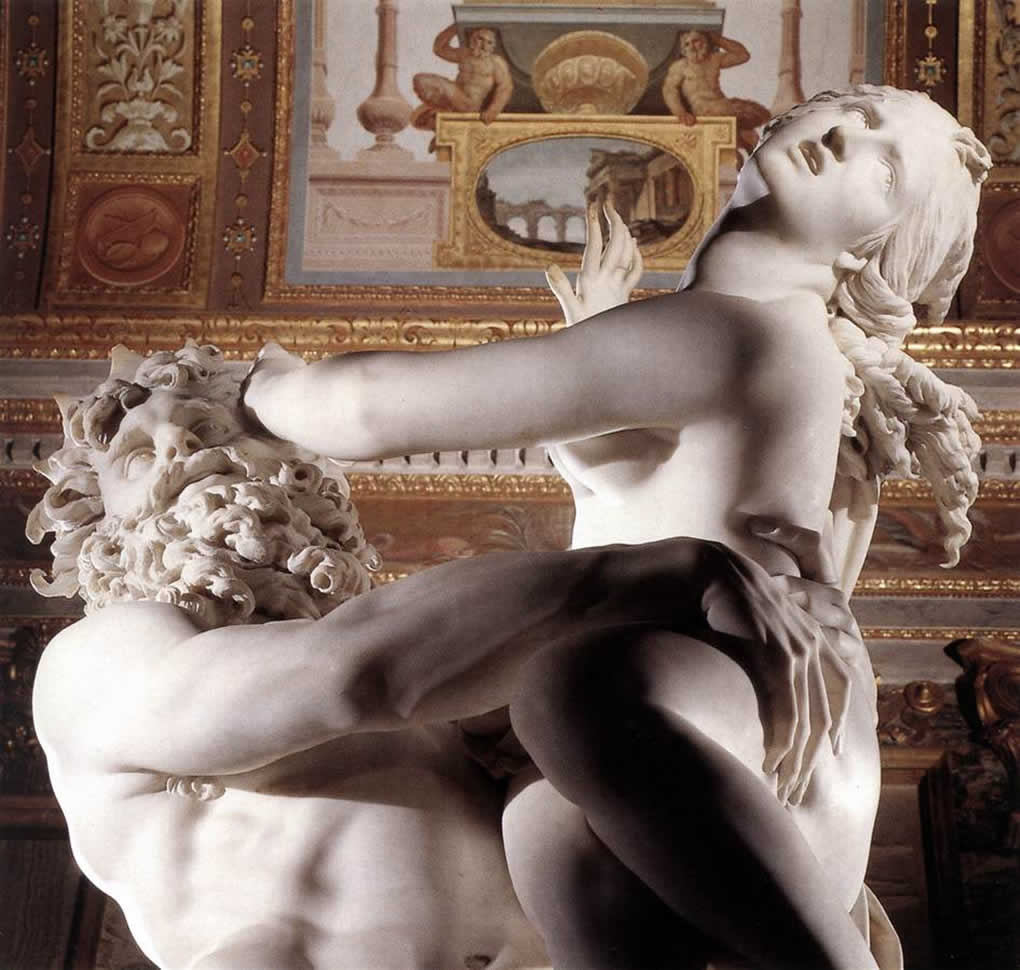
ジャン・ロレンツォ・ベルニーニ作「プロセルピナの陵辱」:冥王星がプロセルピナを拉致するという、もうひとつの傑作彫刻。
The moment you step into the ボルゲーゼのガレリア, you feel why it’s different from larger, more sprawling museums in ローマ. The rooms are intimate, the collection is concentrated, and the art doesn’t sit politely in the background—it demands attention at close range. If you’re coming for プロセルピナの凌辱, that intensity works in your favor. Bernini’s sculpture isn’t a piece you “see once” and move on from. It’s a work that changes as you move, because the story is carved into motion, into pressure, into the exact second where everything turns from chase to capture.
See Bernini’s Proserpina sculpture inside the Borghese Gallery
What makes ベルニーニ unforgettable here is how physical the illusion feels. From a distance, you read the myth immediately: Pluto carrying Proserpina, her resistance, his force, the imbalance of power frozen in marble. But the real shock arrives when you approach. You start noticing that the sculpture is built from contrasts that shouldn’t be possible in stone: softness against hardness, skin against muscle, hair against bark-like texture, tears against polished cheek. Your mind knows it’s marble. Your eye keeps trying to argue otherwise. The closer you look, the more the craft becomes the story, because Bernini doesn’t “illustrate” the moment—he makes it happen right in front of you.
A Borghese visit rewards strategy, not speed. The gallery’s format means you’ll be entering at a scheduled time, and your visit is designed to be focused rather than open-ended. That’s a gift if you have a target artwork. Go in with a plan: first, find プロセルピナの凌辱 and give it your best attention early, while your eyes are fresh. Then, use the rest of the visit to let the surrounding collection sharpen your perception. When you return to Bernini—even for just two minutes—you’ll notice more. The room around the sculpture matters because it teaches your eye to see what makes this piece exceptional: the boldness of the narrative moment, and the precision required to carry it off.
This is also the perfect work for “slow circling.” One angle gives you control and momentum, another gives you panic and resistance, another reveals the sculpture’s most famous technical miracle: the sense of pressure and softness where a hand meets flesh. Don’t rush that reveal. Walk around quietly, pause, and let the sculpture “edit” itself as the viewpoint shifts. This is where the ボルゲーゼのガレリア feels like a private collection again: the rooms invite a closer encounter than you’d expect from one of Rome’s most in-demand museums.
Timed entry strategy for your Borghese Gallery slot
Because the entry is timed, the best visits are the ones that feel intentional. Treat your slot like an appointment you want to protect, not a museum you can improvise. Arrive with your essentials ready, and travel light so you’re not distracted by logistics once you’re inside. If you’ve chosen a guided option, listen for the story context, then use the final minutes to return to your favorite angle of Bernini and let your eyes do the work without narration. If you’re visiting independently, your best tool is repetition: one fast pass to orient, then one slower pass to linger where it matters.
If you want to secure your preferred entry time with the supplier, book on Tiqets.com here: Borghese Gallery tickets. Then build the visit around a simple goal: give プロセルピナの凌辱 the kind of time that turns a famous title into a personal memory.
The payoff is that you leave with something more than a photo. You leave with the feeling of having watched marble behave like a living surface, and of having understood—viscerally—why the バロック period wasn’t interested in calm perfection. It was interested in the turning point, the moment of maximum tension, and the emotional charge that makes art feel present. In a city overflowing with masterpieces, that kind of immediacy is rare. The Borghese is one of the few places where it still feels possible, and Bernini is the reason.
Useful Information
Ticket types on Tiqets: This Tiqets page is a Borghese Gallery ticket hub, so the exact product you select can vary by date. Options typically include reserved entry (with a scheduled time), and in some cases guided experiences or hosted entry formats. Choose the option that matches how you prefer to visit: fully independent, or with a guide for structured storytelling and a faster route through highlights.
What entry includes: Your ticket is for the ボルゲーゼのガレリア visit inside ヴィラ・ボルゲーゼ, giving access to the permanent collection where プロセルピナの凌辱 is displayed alongside other major works.
How the visit works: The gallery is managed with scheduled entry times, so your booking will show the time you should arrive and the visit window associated with it. Plan your day around that schedule and avoid stacking another strict timed activity immediately beforehand, so you don’t lose valuable minutes to travel delays.
On-site entry steps: Bring your ticket on your phone and follow the entry instructions shown on your Tiqets voucher. Many museum tickets require quick validation or exchange at the entrance, so arriving a bit early helps you start calmly and use your full visit time for the collection.
Bag and comfort notes: Major museums often have bag procedures and cloakroom rules. To keep the experience smooth, carry only essentials and wear comfortable shoes, as you’ll be standing and moving between rooms.
Cancellations and changes: Cancellation and rescheduling rules depend on the specific Tiqets product chosen (standard entry vs hosted entry vs guided tour). Always review the policy shown during checkout so your booking matches your flexibility needs.
行き方
歴史
Created by ジャン・ロレンツォ・ベルニーニ at the start of the seventeenth century, プロセルピナの凌辱 is one of the defining sculptures of the バロック era. It depicts the myth of Pluto abducting Proserpina, a story that centers on power, resistance, and transformation—ideal material for an artist determined to make stone behave like flesh, hair, and breath. The work is famous not only for its dramatic subject, but for the way it captures a turning point rather than a calm outcome: the instant where struggle and inevitability meet.
The sculpture’s presence in the ボルゲーゼのガレリア is also tied to the collection’s identity. The Borghese is not a museum that feels assembled randomly; it reflects the ambitions of a collector who wanted the strongest works of his time, displayed in rooms built for close viewing. Bernini’s large mythological sculptures became central to that vision, shaping the gallery into a place where visitors encounter masterpieces at an unusually intimate distance.
Within the Borghese setting, the sculpture is experienced not as an isolated object but as part of a broader conversation about art as status, storytelling, and technical bravura. You can see why a collector would want a piece like this: it doesn’t merely show a story, it stages it. The result is a work that still feels contemporary in its emotional force, even centuries after it was carved.
REVIEWS
Amelia (United States)
Luca (Italy)
Sophie (France)
ヒント
Travel light to protect your museum time: The Borghese visit is most enjoyable when entry feels smooth and you can move freely in tight rooms. Bring only essentials, keep your ticket accessible, and avoid carrying bulky items that slow you down or distract you once you’re inside.
Circle slowly and choose two “anchor angles”: Don’t try to absorb the sculpture from one spot. Pick two deliberate viewpoints: one that captures the forward momentum of the abduction and one that emphasizes Proserpina’s resistance and the transformation-like textures. Stay still for a full minute at each before taking photos, so the memory isn’t camera-led.
See Proserpina first, then return for a second look: With a scheduled entry window, your priorities should happen early. Go straight to プロセルピナの凌辱 at the start, then explore other rooms and come back for one final pass. That second look is where the sculpture becomes personal, because you’ll notice how the story changes with angle and distance.
 English
  Italian
  German
  French
  Spanish
  Polish
  Portuguese
  Japanese
  Korean
  Czech
Czech  Chinese
  Russian