
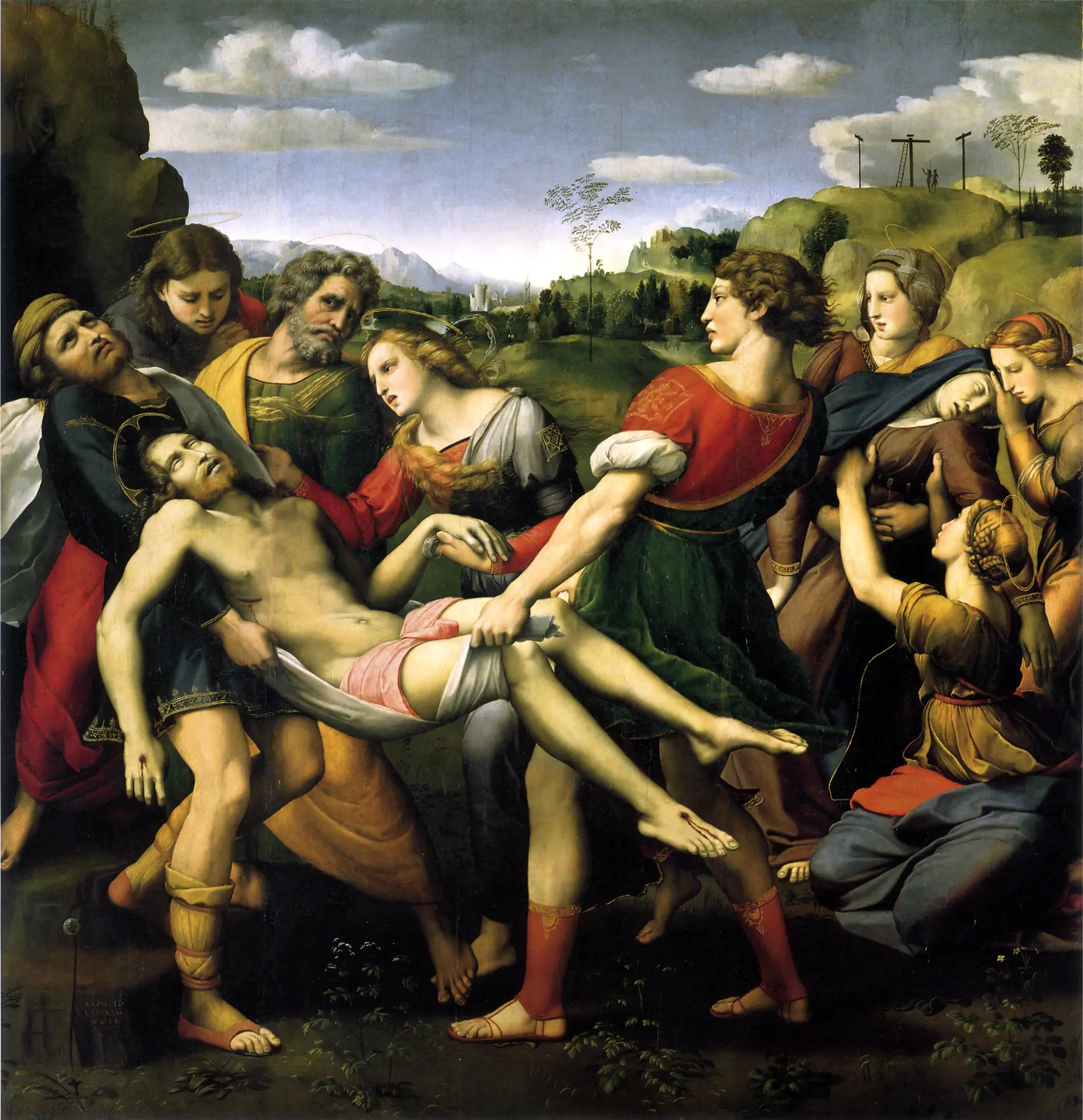
"Die Kreuzabnahme" von Raffael: Ein Meisterwerk der Renaissance, das den zarten Schmerz und die Trauer über den Abstieg Christi vom Kreuz darstellt.
Raphael’s Die Absetzung is a painting you don’t simply “tick off” in Rom. In the Galerie Borghese, it reads like a controlled wave of emotion: the weight of the body, the sorrow that spreads across faces, and a composition that feels engineered to move your eye from grief to grace without ever becoming theatrical. Tiqets describes it as an early 16th-century altarpiece, also known as The Entombment of Christ, and the moment you see it in person you understand why it sits among the gallery’s essential masterpieces.
Raphael’s The Deposition at Borghese Gallery: what to expect
The first thing to know is that the setting changes everything. The Villa Borghese rooms are intimate rather than endless, and that intimacy makes Raphael’s painting feel close and immediate instead of distant and “museumified.” You’re not looking up at it from the far end of a hall. You’re near enough to notice how the scene is built from human decisions: where a hand grips, where a gaze breaks, where the rhythm of bodies leads you through the story. The work rewards patience, because its impact doesn’t come from shock. It comes from clarity, from the feeling that every figure has a role in the emotional choreography.
Raphael’s subject is sorrow, but the experience of seeing it isn’t only sadness. It’s precision. The painting draws you in with a balanced structure that makes the narrative readable even at a glance, and then keeps you there with detail and restraint. If you give it a few minutes, you start noticing how the scene holds together: the way weight is distributed, the way movement is suggested without becoming chaotic, the way grief is expressed through posture as much as through faces. This is why it’s worth arriving with a plan. The Galleria Borghese is famous for being packed with major works, so it’s easy to get distracted. If this painting is your priority, treat it like your anchor and build the rest of the visit around it.
The beauty of the Borghese format is that it encourages that kind of focus. You’re not wandering for half a day hoping to stumble into highlights. You’re entering a concentrated collection designed to be experienced in a fixed window, which pushes you to look with intention. Raphael sits within a broader “masterpiece density” that Tiqets highlights: rooms where one great work follows another, including Renaissance painting and the dramatic punch of Caravaggio elsewhere in the museum. That contrast can make Raphael’s calm authority feel even stronger, because you experience different artistic languages back-to-back and your eye sharpens quickly.
Timed entry rules for a calm two-hour visit
Planning matters here, because the experience is timed and structured. Tiqets explains that time slots are mandatory and divided into two-hour slots, and you’re required to exit at your designated time. That’s not a drawback if you use it well. It means the visit can stay controlled and the rooms can remain more intimate than a typical “open flow” museum. But it also means punctuality protects your art time. Tiqets advises arriving at least 30 minutes before your scheduled entry time, and if you’re late your exit time does not change. In other words, arriving early is not a suggestion; it’s the simplest way to ensure you get the full value from the two hours.
There are also practical entry procedures that shape the start of your visit. Tiqets notes a mandatory bag check and that only small purses or fanny packs are allowed, with medium and large bags needing to be left in the cloakroom. This is the kind of rule that can steal time if you arrive unprepared, so the best strategy is to travel light and keep your essentials minimal. Once you’ve cleared those logistics, the reward is real: you can spend your time inside the rooms instead of spending it in procedures.
If you want your Raphael moment to feel unhurried, use a simple two-pass method. First pass: find Die Absetzung, take in the full composition from a few steps back, and let the scene settle. Second pass: after you’ve seen a few other rooms, come back for a shorter, slower look. That return visit is where the painting often becomes personal, because your eyes are more trained and you notice choices you missed the first time. When you’re ready to lock in your entry slot through the supplier, book with Tiqets.com using this Borghese Gallery ticket page and plan your two hours around the works you care about most.
The final payoff is how the painting follows you out of the room. Raphael’s discipline changes the way you look for the rest of the day: you start noticing composition in street scenes, balance in architecture, light and shadow in the park paths outside the museum. In a city overloaded with unforgettable images, Raphael still manages to recalibrate your attention. And that’s exactly what a Borghese visit is best at: not only showing you famous works, but giving you a sharper way of seeing.
Useful Information
What you’re booking: This Tiqets page is a Galerie Borghese ticket hub, with multiple options depending on how you want to visit. The gallery visit runs on mandatory timed entry, designed as a fixed 2-hour museum slot.
Main options shown: Tiqets lists a standard Reserved Entry ticket for a self-guided visit, plus guided formats such as a Guided Tour und eine Small Group Guided Tour (both shown as 2 hours with a maximum group size of 15 and live guide languages listed on the page). There is also a Private Guided Tour option (shown with a smaller maximum group size), and some combined products that bundle the gallery with another activity (for example, a hop-on hop-off bus tour + reserved entry).
What’s included: Entry gives access to the museum rooms inside Villa Borghese and the permanent collection highlights described on Tiqets, including the “Masterpieces of the High Renaissance” section where Raphael’s The Deposition is presented as a key work. Guided options add a live guide and typically include headsets so you can hear clearly.
How entry works: Plan to arrive early. Tiqets states you must arrive at least 30 minutes before your scheduled entry time, and if you arrive late your mandatory exit time does not change. On arrival, you show your ticket at the entrance and follow on-site procedures.
Bag rules: Tiqets highlights a mandatory bag check. Medium and large bags are not allowed inside, and only small purses/fanny packs are permitted; larger items must be left in the cloakroom. Travel light to protect your museum time and keep movement comfortable in the intimate rooms.
Opening pattern: Tiqets lists the gallery as open Tuesday through Sunday with Monday closure, plus specific holiday closures noted on the page. Always choose the timeslot that best fits your day’s pacing.
Changes and cancellations: Policies vary by ticket type (standard entry vs guided vs private or combined options). Review the exact cancellation and rescheduling rules shown for your selected option at checkout.
WIE MAN DORTHIN KOMMT
GESCHICHTE
The Borghese Gallery grew out of a private collecting vision. Tiqets explains that architect Flaminio Ponzio designed Villa Borghese for Cardinal and art collector Scipione Borghese, who wanted a villa where he could house and display an enormous collection. That origin still shapes the experience today: the museum feels like a carefully staged house for masterpieces rather than a neutral, modern container, and the rooms invite close viewing rather than long-distance scanning.
Tiqets also notes that in 1901 the collection, the gallery, and the surrounding park were acquired by the Italian government and opened to the public. That transition preserved the Borghese’s distinctive character: a museum that “punches above its weight” because it is compact but intensely concentrated. The strict capacity limit and fixed two-hour slots reinforce the same feeling a private collection would have had: fewer people at once, more intimacy, and a visit built on attention rather than endurance.
Within that setting, Tiqets positions Raphael’s The Deposition as a High Renaissance masterpiece, also known as The Entombment of Christ. The page describes it as an early 16th-century altarpiece that captures the sorrow surrounding Christ’s burial and showcases Raphael’s understanding of human emotion and composition. Seen in the Borghese context—where major sculpture and dramatic painting surround you—Raphael’s control becomes part of the gallery’s larger story: different artists, different languages, all placed close enough to feel immediate.
REVIEWS
Hannah (United Kingdom)
Marco (Italy)
Sophie (France)
Tipps
Make Raphael your first stop: In a two-hour slot, priorities belong at the beginning. Go straight to Die Absetzung as soon as you enter, take a few minutes for a full-distance view, then move closer for details. After you’ve visited other rooms, return briefly for a second look. That second look is often the one you remember, because you see more once your eyes have adjusted to the gallery’s pace and density.
Arrive early and travel light: Tiqets highlights strict timing and a mandatory bag check, so protect your visit by arriving at least 30 minutes before your entry time and carrying only essentials. The calmer your entry, the more time you have for the art. A small bag setup also makes it easier to move in intimate rooms without feeling crowded or distracted.
Build buffer around the park walk: The final walk through Villa Borghese is beautiful, but it takes time. Treat it as part of your plan, not an afterthought. If you arrive rushed, you’ll carry that tension into the rooms. If you arrive early, the gallery feels calmer and your viewing time stays intact, which is exactly what you want for a detail-rich work like Raphael’s Deposition.
 English
  Italian
  German
  French
  Spanish
  Polish
  Portuguese
  Japanese
  Korean
  Czech
Czech  Chinese
  Russian